“instructional design is intended to be an iterative process of planning outcomes, selecting effective strategies for teaching and leaning, choosing relevant technologies, identifying educational media and measuring performance”
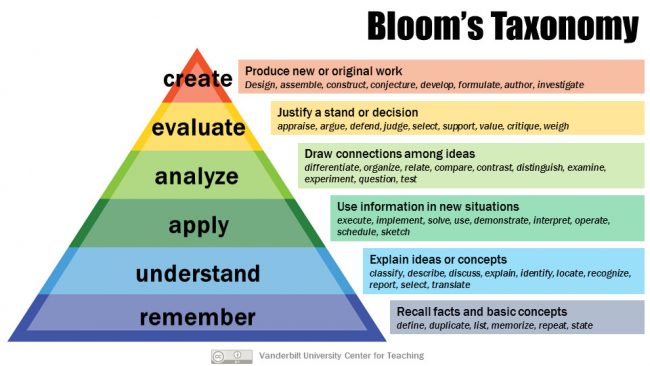
Bloom's taxonomy :It was created in 1956 under the leadership of educational psychologist Dr Benjamin Bloom in order to promote higher forms of thinking in education, such as analyzing and evaluating concepts, processes, procedures, and principles, rather than just remembering facts
Instructional design models:
These are commonly accepted design models:
- ADDIE
- Dick and Carey
- Assure
- Backward Design (Understanding By Design)
- Kemp Design Model
- The Kirkpatrick Model
- Gerlach-Ely Model
ADDIE model

- Analysis phase
The Analysis phase can be considered as the “Goal-Setting Stage.” The focus of the designer in this phase is on the target audience. It is also here that the program matches the level of skill and intelligence that each student/participant shows. This is to ensure that what they already know won’t be duplicated, and that the focus will instead be on topics and lessons that students have yet to explore and learn. In this phase, instructors distinguish between what the students already know and what they should know after completing the course.
- Design stage
Design stage determines all goals, tools to be used to gauge performance, various tests, subject matter analysis, planning and resources. In the design phase, the focus is on learning objectives, content, subject matter analysis, exercise, lesson planning, assessment instruments used and media selection
- Development stage
The Development stage starts the production and testing of the methodology being used in the project. In this stage, designers make use of the data collected from the two previous stages, and use this information to create a program that will relay what needs to be taught to participants. If the two previous stages required planning and brainstorming, the Development stage is all about putting it into action. This phase includes three tasks, namely drafting, production and evaluation. Development thus involves creating and testing of learning outcomes.
- Implementation stage
The implementation stage reflects the continuous modification of the program to make sure maximum efficiency and positive results are obtained. Here is where IDs strive to redesign, update, and edit the course in order to ensure that it can be delivered effectively.
- Evaluation
Evaluation is the stage in which the project is being subjected to meticulous final testing regarding the what, how, why, when of the things that were accomplished (or not accomplished) of the entire project. This phase can be broken down into two parts: Formative and Summative.

No comments:
Post a Comment